Cut Your Expiry and Stock-Loss Costs by 20%. Guaranteed*
Less hands-on stock work at a 10-fridge vaccine distributor
Every dose followed from delivery to administration
The wrong vial gets flagged at the fridge before it ships
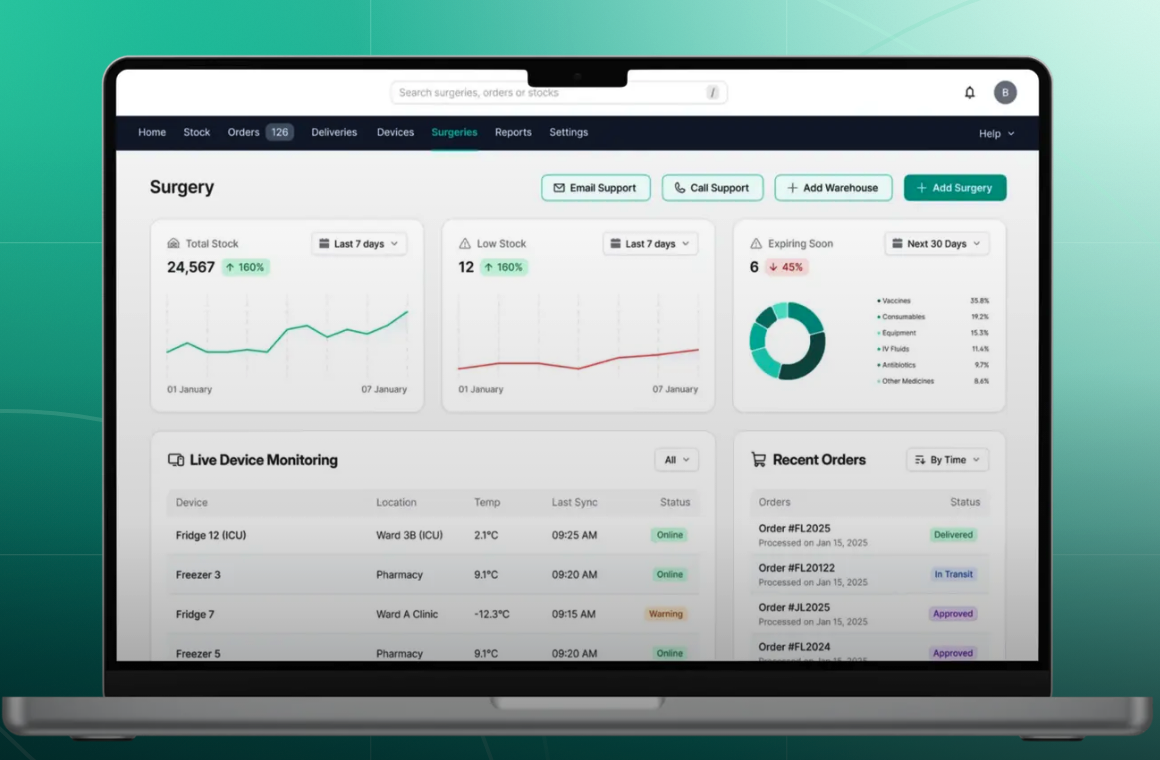
Live alerts the moment a fridge drifts out of range
How Trace360 Goes Live on Your Floor in 60 Days
One team owns the hardware, the software, the ERP connection and the result.
Trace Audit (Days 1 to 7)
Map your sites, batches, cold rooms, current devices and the ERP or WMS you already run.
Your Traceability Blueprint on day 7, plus a baseline of your current expiry, stock-loss and manual-tracing costs. The guarantee is measured against that baseline.
Connect (Days 8 to 45)
Tag every batch and fit readers at your docks, zones and fridge doors. Sensors check every fridge and cold room at least every 30 minutes.
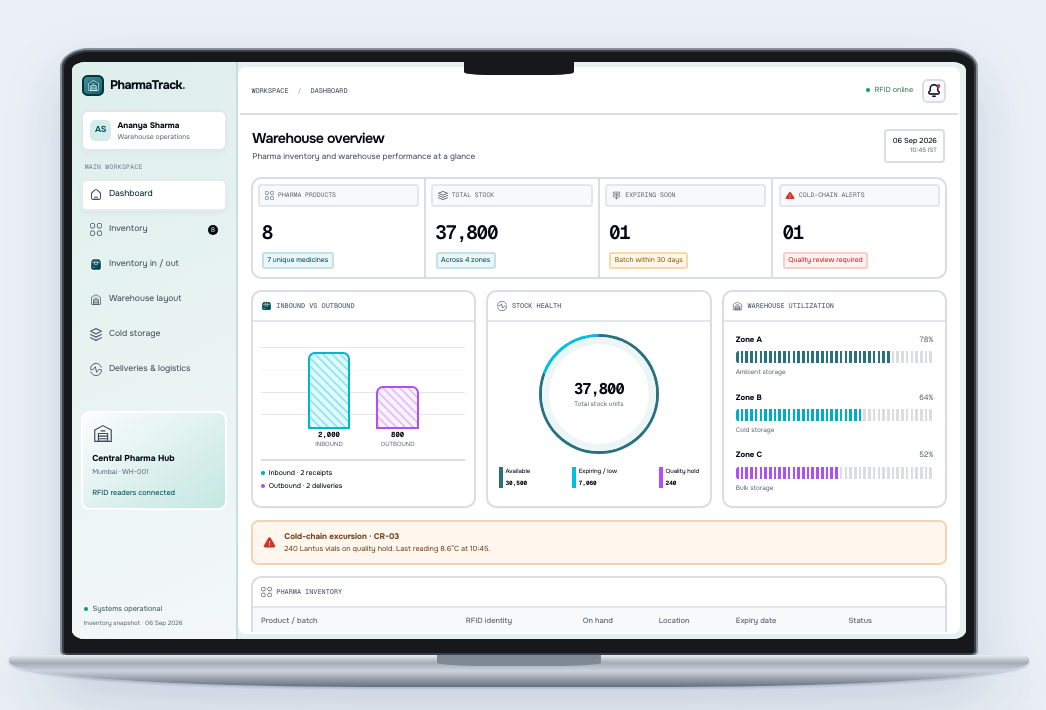
Every movement logs itself with no scanning or counting, and when a reading drifts you see exactly which batches were inside.
Prove (Days 46 to 60)
Bring your first site live on a real-time dashboard.
Out-of-range batches go on quality hold with a named owner, expiring stock is flagged before it gets allocated, and your audit trail exports to PDF whenever an inspector asks.
60 Days of Post-Launch Support
Run the hosting, monitoring and DevOps for 60 days after go-live, then review data quality, device health and new gaps with you every quarter.
Your IT team doesn't have to learn and babysit a new system.
Answer a few short questions. No obligation.
Real Results From Our Clients
RFID and cold-chain systems we have built and run for pharma, healthcare and banking teams.

Hi, I'm Pavneet.
I started Stackera in [2018] to take on engineering problems most teams avoid. Our first big systems were bank payment platforms, including the one behind a major Indian bank's FASTag toll payments, and that is where we learned RFID at scale. Since then we have built RFID tracking for vaccines, pharmacy warehouses and cold storage, including a vaccine project on the Isle of Man where I was on site fitting the readers to the fridges.
Today my team of 34 engineers in Toronto and Pune builds Trace360 for pharma distributors and cold-chain operators. We design the readers, sensors, integrations and dashboards ourselves, connect them to the systems you already run, and stay on until your numbers move.
Answer a few short questions. No obligation.
Frequently Asked Questions
We already run an ERP or WMS. Do we have to replace it?
No. Trace360 connects to the ERP or WMS you already use. Your ERP keeps handling orders, and Trace360 adds what it can't see: where each batch physically is, what temperature it has been through and who moved it.
How does the 20% guarantee work?
In the first 7 days we measure your current expiry, stock-loss and manual-tracing costs with your team, and that becomes your baseline. If those verified costs are not down at least 20% against it [within X months of go-live], we keep working with you at no extra cost until they are. The full terms are written into your project agreement.
We tried RFID before and it didn't work. Why would this be different?
When RFID fails, the tags are rarely the problem. Usually the readers were placed where it was convenient instead of where stock moves, the data never reached the ERP, and nobody owned the system after launch. We place readers using your Trace Audit, connect the data to your systems, and run the system ourselves after go-live.
What happens after I fill in the form?
If your answers show we can help, you go straight to a calendar and book a call with our team. On the call we look at how stock moves through your operation and where it goes missing. If Trace360 fits, we show you how it would work on your sites.
How are you different from other custom development agencies?
Most traceability projects get split between vendors. One firm writes the software, another supplies the readers and sensors, and someone else runs the servers after launch, so when something breaks everyone points at someone else. We build all of it in-house, from the RFID hardware and software to the ERP connection and the hosting after go-live. You deal with one team and one named lead, and we have already built this for vaccine distributors and pharma warehouses.
Cut Your Stock-Loss Costs by 20%. Guaranteed.
Answer a few short questions. No obligation.